
A chatbot talks. An AI agent gets work done. That one line explains most of the AI agent vs chatbot question, but it does not tell you which one your business should buy. The wrong choice can mean wasted money, or a system with more power than you can safely control.
This guide explains both in plain words, then gives you a simple way to decide. It is written for business owners, so you will not need a technical background.
#What is a chatbot?
A chatbot is software that holds a conversation with a person through text or voice. Older chatbots follow fixed scripts and menus. Newer AI chatbots use a large language model to understand free-form questions and write natural replies. Either way, its main job is to answer or guide.
A large language model, or LLM, is the type of AI behind tools such as ChatGPT. It has learned language patterns from huge amounts of text.
Common chatbot jobs include:
- Answering questions about opening hours, delivery or returns
- Collecting a name and phone number from a website visitor
- Pointing customers to the right help article
- Passing a conversation to a human team member
If you want one on your own site, our page on AI chatbots for business shows what is involved.
#What is an AI agent?
An AI agent is software that works toward a goal by deciding its own steps and using tools. It can read information, make a plan, take actions in other systems and check its results. A person sets the goal, and the agent works out how to reach it, within limits you set.
Anthropic, the company behind Claude, draws a useful line. In a workflow, software follows steps written in advance. In an agent, the AI directs its own process and chooses which tools to use.
Here is what that looks like. A customer writes, "My order arrived damaged." An AI agent could:
- Look up the order in your store
- Check your refund policy
- Create a replacement order
- Email the customer with tracking details
- Ask a manager to approve anything over the limit you set
A chatbot could explain your return policy. An agent could complete the return.
#What is the main difference between an AI agent and a chatbot?
The main difference is action. A chatbot mostly responds with information, while an AI agent plans and carries out tasks across your business systems. The more a tool can do by itself, the more value it can create, and the more careful you must be with it.
| Question | Chatbot | AI agent |
|---|---|---|
| Main job | Answer and guide | Complete a task |
| How it works | Script or one AI reply at a time | Plans several steps and adapts |
| Access to your systems | Often none, or read only | Can read and change data |
| Memory | Usually one conversation | Can use past context and business data |
| Setup effort | Lower | Higher |
| Main risk | Gives a wrong answer | Takes a wrong action |
| Needs human approval? | Rarely | Yes, for important actions |
| Best for | Common, repeated questions | Multi-step work across tools |
Many products sit between these two columns. An AI chatbot that can look up an order is more capable than a script, yet it may still not be a true agent. Ask what it can actually do.
#When is a chatbot the right choice?
A chatbot is the right choice when most requests are predictable and the answer already exists somewhere. It is cheaper to run, simpler to test and easier to trust. Many businesses need nothing more.
Choose a chatbot when:
- A small set of questions makes up most of your messages
- Your replies come from a clear FAQ, price list or policy page
- A wrong answer can be corrected by a person without much harm
- You mainly want to capture leads outside office hours
#When do you need an AI agent?
You need an AI agent when the work has several steps, the path changes from case to case, and a person currently spends real time moving between tools. Anthropic recommends agents for open-ended problems, where the number of steps cannot be known in advance.
Good signs include:
- Staff copy information between your CRM, inbox and spreadsheets
- Each case needs some judgement, not just one fixed rule
- The cost of a mistake is limited, or a person can approve the final step
- You can give the agent clean data and clear rules
Our AI agents service starts with one narrow job like this, rather than trying to automate a whole department.
#When do you need neither?
You need neither when the task follows the same fixed steps every time. Ordinary automation is cheaper and more reliable for that work. Anthropic's own advice is to start with the simplest solution and add complexity only when it is needed.
For example, "when a form is submitted, add the lead to the CRM and send a welcome email" needs no AI at all. Simple workflow automation will do it the same way every time.
A clear FAQ page or a better contact form can also beat a chatbot. Technology should fix a real problem, not decorate your website.
#Which one does your business need? Use this table
Start with the job you want done, not the technology. Find the row closest to your situation.
| The job | Best starting point | Why |
|---|---|---|
| Answer the same questions all day | AI chatbot | Answers exist, and the risk is low |
| Capture leads at night | Chatbot with a simple form | Clear goal and few steps |
| Add every new lead to your CRM | Plain automation | Same steps every time |
| Sort a busy support inbox | AI with human review | Needs judgement, and people stay in control |
| Process routine returns | AI agent with limits | Several tools and steps, with clear rules |
| Research and prepare sales outreach | AI agent, human sends | Variable work, and sending needs care |
| Approve refunds, contracts or payments | Keep a person in charge | A mistake costs too much |
| Medical, legal or money advice | Specialist advice, not a general bot | High risk for the customer |
#What are the risks of chatbots and AI agents?
The main chatbot risk is giving wrong information, and the main agent risk is taking a wrong action. Your business can be responsible for both.
In a February 2024 decision, a Canadian tribunal held Air Canada responsible for wrong information its website chatbot gave a customer about bereavement fares. The airline argued it could not be held responsible for information given by its chatbot. The tribunal rejected that. The lesson is simple: what your bot says on your website is your responsibility.
AI agents add another layer. OWASP, a respected security organization, calls this problem excessive agency. It happens when a system has more tools, permissions or freedom than the job requires. A confused or manipulated agent can then cause real damage.
Protect your business with these rules:
- Give the least access possible. If it only needs to read orders, do not let it delete them.
- Require human approval for refunds, payments, mass emails and data changes.
- Keep a log of what it did and why.
- Set limits on amounts, number of actions and working hours.
- Tell customers they are talking to AI, and make reaching a person easy.
- Test with difficult cases before real customers use it.
#How can a chatbot grow into an AI agent?
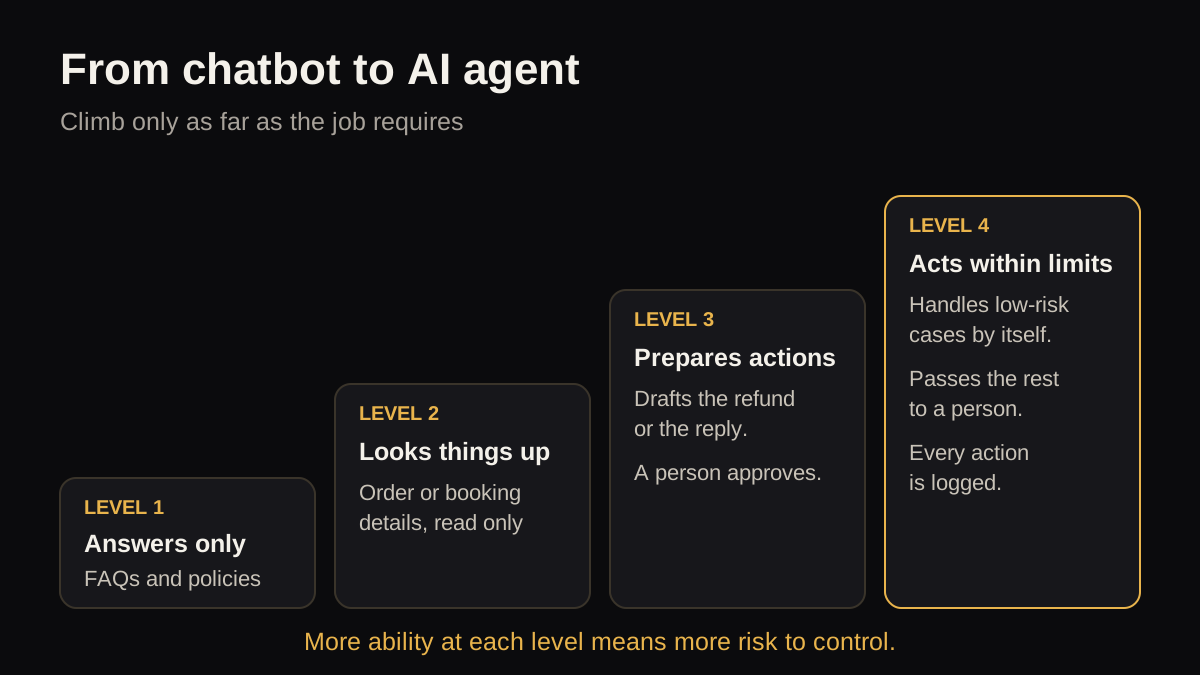
A chatbot can grow into an agent one permission at a time, which is usually safer than launching a full agent on day one. Each stage gives you evidence before you take the next step.
- Answer only. Connect it to your approved FAQs and policies.
- Look things up. Let it read order status or booking details.
- Prepare actions. It drafts the refund or reply, and a person clicks approve.
- Act within limits. It handles low-risk cases by itself and passes the rest to a person.
Move forward only when the current stage is working. Check how often it is right, how often people must step in and whether customers are happy.
#How do you spot "agent washing"?
Agent washing means selling an ordinary chatbot or automation tool under the "AI agent" label. Gartner warned about this in June 2025. It said only about 130 of the thousands of vendors offered real agent technology, and it predicted over 40% of agentic AI projects would be canceled by the end of 2027. It gave rising costs, unclear value and weak risk controls as the reasons.
Before you buy, ask a vendor these questions:
- What actions can it take without a person, and in which systems?
- Who approves high-impact actions?
- What happens when it is unsure?
- Can I see a log of every action?
- How is my customer data stored and used?
- How will we measure whether it is working?
A good vendor answers these clearly. A vague answer tells you a lot.
#How should you decide?
Decide by choosing one repeated task, measuring what it costs you now, and using the simplest tool that solves it. For most small businesses, that means starting with a well-trained chatbot or simple automation. Add agent abilities only when a real bottleneck justifies them.
Write down the task, how often it happens, what data it needs and what a mistake would cost. Those four answers usually make the choice obvious.
Not sure which one fits? Bring that one task to a free 30-minute call. We will tell you honestly whether you need a chatbot, an agent or something much smaller. You can also try our free business tools first.